

Storm clouds are gathering. Not over Europe, as in 1938; today they are everywhere. And about everything.
We face a polycrisis impacting all spheres of our personal, familial, community, national and global life.
We are living through a period of a profound technological productive revolution as fundamental as the Agrarian or the Industrial revolutions with little popular recognition or consideration of the far-reaching implications thereof.
And we are making a mess of it. The open societies of the Western liberal democracies are increasingly imperilled by the inefficacy of reflexively-centrist social-democratic governments and the rise in the perceived appeal of nationalist populism and populist leaders offering (largely illusory) simplistic explanations and promising definitive action.
We all know the symptoms — environmental, social, political, economic decline (real, relative or imagined) accompanied by the psychology of political inefficacy and, socially, absence of agency.
What about the underlying root causes of the inefficacy, itself? Why are liberal democratic governments seemingly so powerless?
Our understanding of root causes frames our proposed actions and the initiatives in this proposal.
Root causes of the problem set we all now face
The context
First clearly enunciated by US journalist-turned-futurist Alvin Toffler in his masterful The Third Wave in 1980, Western societies and economies are currently evolving through a productive revolution every bit as disruptive as the earlier Agrarian Revolution and the Industrial Revolution, even as we are struggling to cope with the impacts of the latter stages of widespread industrialisation: globalised trade and transportation, human mobility and the impacts of widespread combustion of fossil-based hydrocarbons amplifying the atmospheric retention of the Earth’s thermal radiation from solar radiation — the greenhouse gas phenomenon that makes this planet conducive to the evolution of, and habitable for, humans and a vast array of other species.
Improved health science reducing infant mortaility and adult disease and improved nutrition combining to produce greater longevity have led to explosive population growth, producing consumptive demands for resources that have threatened ecosystems that are natural habitats of wildlife and the extraordinary bio-diversity this planet offers. The result has been widespread environmental destruction and unprecedented despeciation.
Western liberal democracies are experiencing polycrisis (Morin, 1995) — an overwhelming series of complex and inter-connected crises impacting political conduct and democratic legitimacy, economic performance and decision-making, demographic change, movement of people, social cohesion and tolerance, ecology and our environment, including related to anthropogenically-induced global climatic change resulting from burning of hydrocarbons.
Citizens of Western liberal democracies are secularly losing faith in the capacity of their elected governments to grapple with these challenges and effect timely solutions. They have sound reasons for doing as fundamental problems are clearly identified, but action thereon is limited and ineffectual. Citizens are also losing faith in the vital institutions that sustain open societies — liberal democracies and their political processes — and are increasingly providing electoral support to nationalist populists who will erode further those protective institutions.
Since the collapse of the Soviet Union and the 'triumph of capitalism', increasingly laissez-faire regulatory environments and changes in communication, transportation and other productive technologies, punctuated by material financial and economic crises, have resulted in very high re-concentration of wealth within in Western economies, creating percived declines in relative welfare, even as hundreds of millions of the world's citizens have faced rising standards of living. This has resulted in social and political discontent among those income cohorts who have experienced relative economic decline, especially in the developed West. This outcome is most clearly presented in analysis completed at the World Bank in 2013 by Lakner and Milanovic (now of CUNY), which has become widely known as Milanovic’s elephant curve.
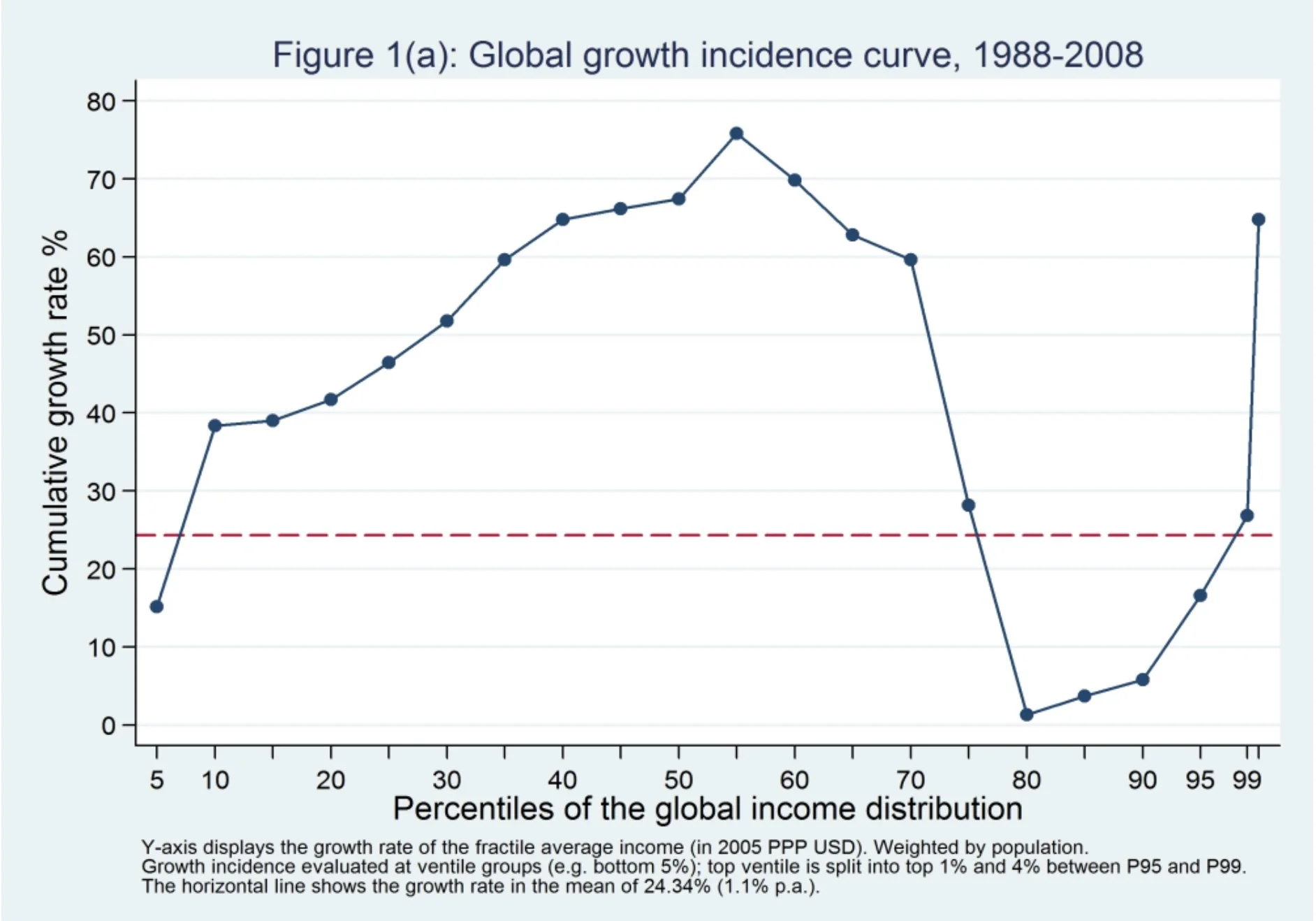
Gains were lowest among people around the 80th percentile globally most of whom are in the lower middle class of developed economies (Wellisz, 2019).
It is in this group — the lower middle class of developed economies — where the support for nationalist populists has grown most strongly in the US, UK & Europe. It is from the electoral support of nationalist populist strongmen (or perceived strongmen) that the greatest endogenous threat to open, liberal democracies will arise.
Pernicious causal factors
Post-structuralist, post-truth sophistry
Politics in Western, previously-liberal democracies is becoming increasingly untethered to truth, enabling populist politicians to ignore or discard democratic norms and institutions;
Social media echo chambers
Social media are becoming increasingly algorithmically-targeted echo chambers in which citizens' access to news and other information is curated according to analysis of their ideological preferences; partisanship and political rancour is increasing, further straining the effectiveness of government and political legitimacy.
Sensationalist news coverage
Traditional news media, faced with declining audiences, have increasingly resorted to sensationalised news. Immediacy of visual coverage has replaced quality of contextual presentation as the news imperative.
Swathes of the attentive public are experiencing news fatigue. Industry research shows that viewers want information but the also crave context, insight and diverse perspectives. These are not on offer from mainstream media sources.
Academic disengagement from the public sphere
Universities, despite extensive state funding (£10.3 billion per annum) from the UK Exchequer), provide only limited input to political discourse; experts are increasingly disdained as, in public perception, opinion approaches equivalency with fact-based, reasoned argument.
The splintering of political economy
Political economy has been replaced as the foundational discipline of government policy analysis and formation by the separated disciplines of an increasingly mathematised and esoteric economics, political science and public policy.
Academic economics has become increasingly absorbed by esoteric problems of mathematical manipulation, even as there is growing recognition that the assumptions required to achieve mathematical tractability are fundamentally flawed. Increasingly, economics offers few insights to policy makers in either private or public sectors.
Economics as physics envy
Despite it offering only a narrow range of insights, there are few sources of robust challenge to the dominant neo-classical assumptions of economics. Incursions from the insights of institutional economists are resisted and criticised as unscientific (to wit, not mathematically expressed) and gain little traction in academic departments of economics. Students at post-graduate and even undergraduate level are selected for their mathematical prowess. Non-mathematically expressed economic logic is routinely dismissed as unscientific or heterodox.
As Austrian School economists have long claimed, economics is the study of the interactions of individual human actors acting in a social context of exchange (demonstrating recursive inter-subjectivity also known as reflexivity [Soros, 1987]). Because it involves social interaction, it is essentially complex and uncertain. Therefore, the ontological foundations of orthodox economics are questionable.
Politicians and many political commentators are routinely economically illiterate; the policy-formulating technocracy is increasingly unschooled in fundamental concepts of political economy and methods of economics analysis.
Poor teaching of public policy
Public policy is, typically, taught from a process control perspective by political theorists rather than analytically by economists. Complexity and second- and subsequent-order consequences of policy actions are seldom considered.
The detachment of the language of rights from reciprocal and countervailing duties and responsibilities
There is, today, quite properly, considerable reference to individuals’ and citizens’ rights. However, implicit in those rights are also extensive reciprocal and corresponding duties and responsibilities, implied by, for example, Kant’s second formulation of the categorical imperative, J.S. Mill’s harm principle and Popper’s critical rationalism, his attitude of readiness, and his consequentialist choice of reason as recognising “the rights and obligations of those who want to learn from their fellow human beings” (Popper (1994) in Neimann, 2021).
Shorn of these duties and responsibilities, liberal democracy equates merely to electoral or procedural democracy and the assertion of rights becomes increasingly perceived as zero-sum, competitive conflictual and ideological. This is the procedural democracy of self-interest in which the institutions supporting Popper’s protectionist state come under threat. This is, increasingly, where we find ourselves politically. It is not a place consistent with the preservation of an open society.
These pernicious causal factors are those we aim to address with the initiatives outlined in the proposal we will develop if we can secure funding. It is for the funding to develop the proposal that we are appealing to Open Society Foundations.